
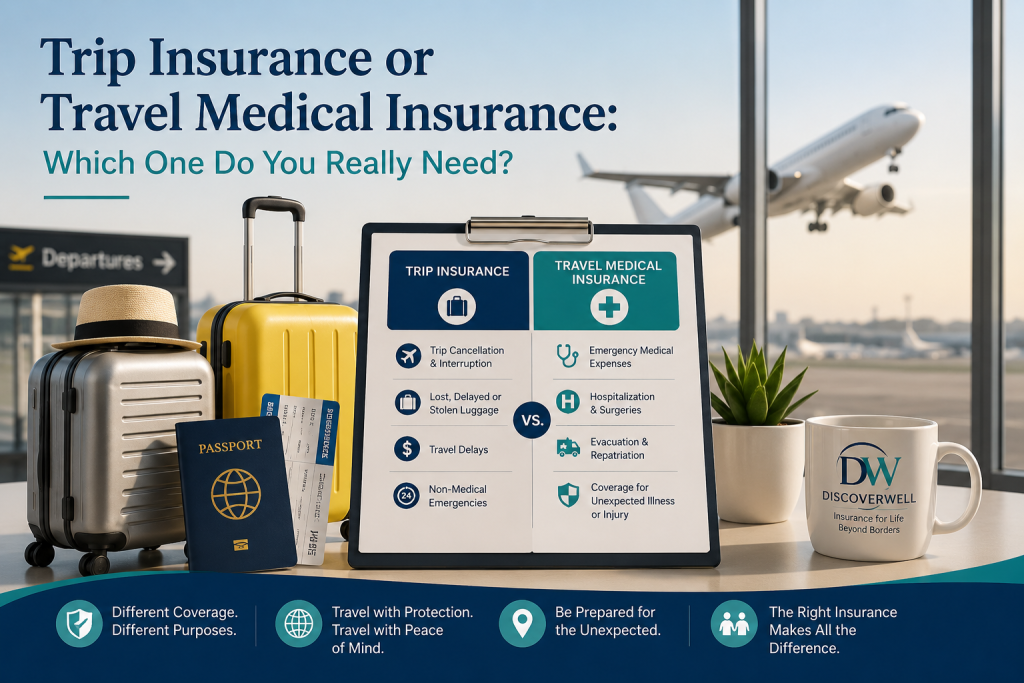
Trip Insurance or Travel Medical Insurance: Which One Do You Really Need?
Trip insurance and travel medical insurance are often talked about interchangeably, but they aren't the same thing.
Both can provide important protection when you're traveling, and often there is some overlap between the two, but they are designed to protect against different types of risk.
Trip insurance primarily protects the financial investment you've made in your trip. Travel medical insurance primarily protects you against unexpected medical expenses while you're away from home.
Depending on where you're traveling, how much you've prepaid, your existing health coverage, and the type of trip you're taking, you may need one, the other, or possibly both.
What Is Trip Insurance?
Trip insurance, sometimes called trip protection, is designed primarily to protect the money you've invested in a trip.
Depending on the policy, coverage may include:
- Trip cancellation – reimbursement for eligible prepaid, nonrefundable expenses if you have to cancel for a covered reason
- Trip interruption – coverage for certain additional expenses or unused trip costs if you need to return home early for a covered reason
- Travel delays – reimbursement for certain expenses caused by a qualifying delay
- Baggage loss or delay – benefits if your luggage is lost, stolen, damaged, or significantly delayed
- Emergency medical coverage – many comprehensive trip insurance policies also include some medical coverage while traveling
- Emergency medical evacuation – transportation to an appropriate medical facility when medically necessary, subject to the policy terms
Trip insurance can be particularly valuable when you've made a significant nonrefundable investment in airfare, hotels, cruises, tours, or other travel arrangements.
An Example
Suppose you've prepaid $12,000 for a European cruise and flights, but several days before departure you become seriously ill and can't travel.
If your illness meets the policy's definition of a covered reason and you've met the other policy requirements, trip cancellation coverage may reimburse eligible nonrefundable expenses.
Without trip cancellation coverage, you could potentially lose much of what you've prepaid.
What Is Travel Medical Insurance?
Travel medical insurance has a different primary purpose: helping cover unexpected medical expenses while you're traveling outside your home country.
Depending on the policy, benefits may include:
- Emergency and unexpected medical treatment
- Hospitalization
- Physician and specialist services
- Prescription medications related to a covered illness or injury
- Emergency medical evacuation
- Repatriation
- Certain emergency dental treatment
- Telemedicine or assistance services
Travel medical insurance generally isn't intended to reimburse you because you've decided not to take a trip or because a flight was delayed. Its primary purpose is your health and medical risk while traveling.
An Example
You're hiking in Switzerland and suffer a serious injury requiring hospitalization.
Your U.S. health insurance may provide limited international benefits—or potentially none at all—depending on your plan.
A travel medical policy can provide coverage for eligible medical treatment abroad, along with assistance coordinating care and, when medically necessary and covered by the policy, emergency medical evacuation. Many travel medical insurers also offer 24/7 assistance services and may be able to arrange direct payment or a guarantee of payment with a hospital in the event of a covered emergency.
While healthcare can cost less in many countries than it does in the U.S., a serious illness or injury can still result in significant expenses. Some hospitals may also require payment or proof of financial responsibility before providing non-emergency treatment, making access to an insurer's international assistance services particularly valuable.
That's a very different financial risk from losing the money you've prepaid for a hotel or other travel arrangements.
Trip Insurance vs. Travel Medical Insurance
Here's the simplest way to think about the distinction:
| Trip Insurance | Travel Medical Insurance | |
|---|---|---|
| Primary purpose | Protect your financial investment in the trip | Protect against medical expenses while traveling |
| Trip cancellation | Often included | Generally not |
| Trip interruption | Often included | Generally limited/not the primary purpose |
| Travel delays | Often included | Generally not |
| Lost/delayed baggage | Often included | Generally not |
| Emergency medical | Often included, but limits vary | Primary benefit |
| Medical evacuation | Often included | Commonly included |
| Pricing | Often influenced by trip cost | Often influenced by age, destination, trip length and coverage |
One important point: these categories can overlap.
Many comprehensive trip insurance plans include emergency medical benefits, while some travel medical policies include limited travel-related benefits. That's why it's important to look at the actual policy rather than relying solely on the name of the product.
Which Type of Coverage Do You Need?
Start by asking yourself what financial risk you're trying to protect against.
Consider Trip Insurance If:
You've prepaid a substantial amount for your trip and would experience a meaningful financial loss if you had to cancel or interrupt it.
This can be particularly relevant for:
- Cruises
- Guided tours
- Resort packages
- Expensive international airfare
- Family vacations with significant prepaid costs
- Health & wellness, cultural, or educational retreats
Consider Travel Medical Insurance If:
Your biggest concern is having adequate medical coverage while outside your home country.
It may be particularly important if:
- Your domestic health insurance provides limited international coverage
- You're traveling for an extended period
- You're visiting a destination where medical evacuation could be extremely expensive
- You're a Medicare beneficiary traveling internationally
- You want higher medical or evacuation benefits than those included with a trip protection policy
What If You Want Both?
You don't necessarily have to choose.
Many comprehensive travel insurance policies combine trip cancellation and interruption benefits with emergency medical and evacuation coverage.
The important question is whether the medical benefits included in the trip policy are sufficient for your particular situation.
For example, a traveler with a $15,000 prepaid cruise may be primarily concerned about cancellation coverage, while someone spending three months abroad with relatively few prepaid expenses may care much more about robust medical benefits.
The appropriate solution could be very different for those two travelers.
What About the Travel Insurance That Comes With Your Credit Card?
Some credit cards include useful travel protections, but don't assume they replace a travel insurance policy.
Benefits vary significantly by card and may include certain protections for trip cancellation, delays, rental cars, or baggage. Medical benefits and emergency evacuation coverage may be limited or absent.
Before relying on credit-card coverage, review exactly what's included, the benefit limits, exclusions, and what you must do to qualify for coverage.
What About Medicare When Traveling Internationally?
Original Medicare generally provides very limited coverage for healthcare received outside the United States, although there are some exceptions.
Some Medicare Supplement plans provide limited foreign travel emergency benefits, and Medicare Advantage plans vary in the international emergency and urgent-care benefits they provide. Keep in mind that even if you have a benefit, it may have a limit and be on a reimbursement basis only, which means in the event of a true emergency, you may not have access to the support and coverage you need.
If you have Medicare, don't assume your coverage will follow you abroad. Review your existing benefits before traveling and determine whether additional travel medical coverage makes sense.
Questions to Ask Before Buying Travel Insurance
Before choosing a policy, consider:
- How much of my trip is prepaid and nonrefundable?
- What would I lose financially if I had to cancel?
- Does my existing health insurance provide emergency support and coverage internationally?
- What is the policy's medical coverage limit?
- How much emergency evacuation coverage is provided?
- Are pre-existing medical conditions covered or eligible for a waiver?
- What reasons for cancellation or interruption are actually covered?
- Are there exclusions related to my planned activities or destination?
- What deductibles or other out-of-pocket costs apply?
- How does the claims process work?
The cheapest policy isn't necessarily the best value. The goal is to understand which risks matter for your particular trip and whether the policy adequately protects against them.
Choosing the Right Coverage for Your Trip
There's no single travel insurance policy that's right for every traveler.
Someone taking a $20,000 cruise has very different insurance considerations from someone taking an inexpensive flight to Europe for six weeks. A healthy 30-year-old backpacker has different concerns than a Medicare beneficiary traveling internationally.
Understanding the difference between protecting the cost of your trip and protecting yourself against medical expenses abroad is a good place to start.
Not sure which type of coverage makes sense for your trip? DiscoverWell can help you compare travel medical and trip protection options based on your destination, trip costs, existing health coverage, and the type of protection you're looking for.